Modern buildings are becoming smart – filled with IoT sensors and automated controls that continuously fine-tune the environment. This connectivity allows facilities to drastically cut energy waste while improving occupant comfort, safety, and convenience. From heating and cooling systems that adjust to actual use, to lights that turn off when rooms empty out, IoT-enabled buildings save money and create healthier, more pleasant spaces. In this guide, we explore how smart HVAC and lighting controls work, how predictive maintenance prevents problems (like elevator outages) before they happen, and the many ways IoT upgrades enhance the daily experience for occupants. We also touch on challenges (like integrating diverse devices securely) and why smart building technology is quickly moving from a nice-to-have to a must-have – especially as energy costs rise and sustainability regulations (in Europe and beyond) push for greener, more efficient buildings.
Cutting Energy Waste with Smart HVAC and Lighting
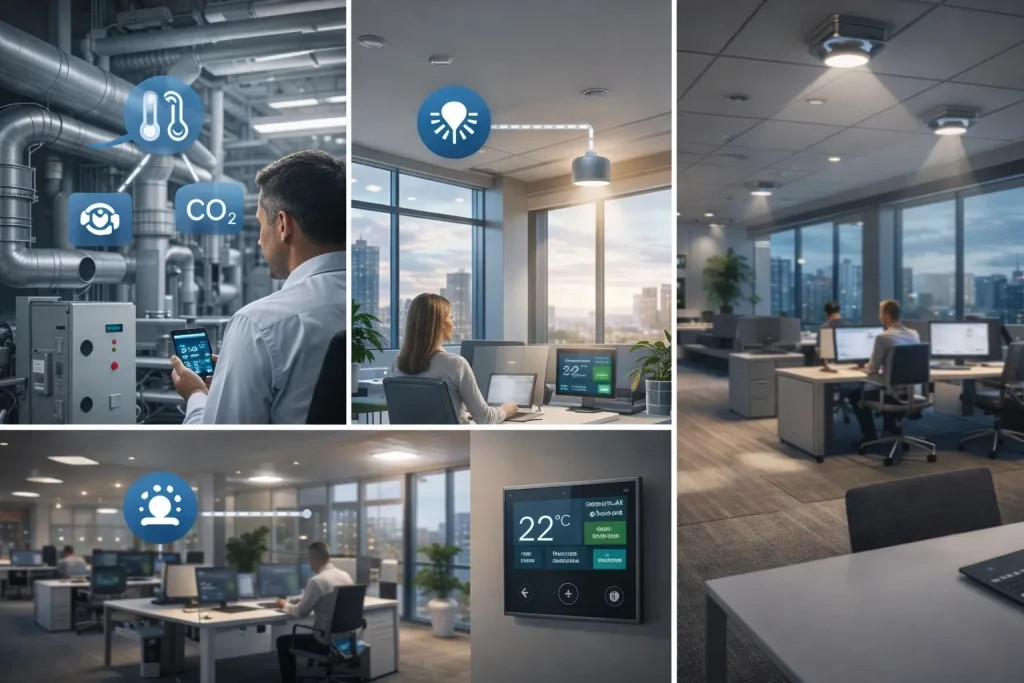
Heating, cooling, and lighting are by far the biggest energy hogs in a typical building. HVAC (heating, ventilation, air conditioning) often accounts for around 30–40% of a building’s electricity use, and lighting isn’t far behind. Traditionally, these systems run on fixed schedules or manual settings, which leads to a lot of wasted energy – the U.S. EPA estimates commercial buildings waste about 30% of the energy they consume. Smart building IoT solutions reduce this waste by continuously adjusting HVAC and lighting in response to real-world conditions.
IoT sensors (like thermostats, temperature probes, CO₂ and humidity sensors, occupancy/motion detectors, light level sensors, etc.) feed data into a Building Management System or cloud platform that makes intelligent decisions. For example, if many people crowd into a conference room, CO₂ and temperature sensors detect the change and signal the ventilation and cooling to ramp up. Conversely, when areas are unoccupied, smart systems can reduce heating or cooling and switch off lights. Advanced algorithms (often AI-driven) can even learn usage patterns and weather forecasts to predict the optimal settings – for instance, pre-cooling a space before a meeting starts, then saving energy when historical data shows a daily lull. According to industry research by Transforma Insights, simply adding IoT-based automation for HVAC and lighting can yield enormous savings: 20–25% of HVAC energy and 35–40% of lighting energy can be saved through smart controls. In practice, that translates to 10–20% lower electricity bills overall for a fully IoT-enabled building. These efficiency gains not only cut costs but also significantly reduce the building’s carbon footprint. In fact, one analysis found that widespread use of smart building solutions globally could trim total energy consumption by about 3–5%, a huge impact at city or national scale.
How are such savings achieved? IoT-based building automation employs a range of strategies:
- On-Demand HVAC: Instead of running heating or AC at a constant level, the system adjusts output based on real-time occupancy and air quality. If sensors show an office floor is empty after 6pm, the building can automatically set back the thermostats (e.g. let temperature drift a few degrees) to avoid conditioning an empty space. Likewise, smart vents or variable air volume controls can deliver more cooling only to the rooms that need it. This granular, zoned approach avoids the common scenario of conditioning an entire floor for just a few people. AI algorithms can further optimize HVAC by learning daily occupancy patterns and even responding to electricity price signals or weather changes (e.g. pre-cooling early if an afternoon heatwave is forecast, then coasting when prices peak). The result is maintaining comfort with minimal excess. Peer-reviewed research published in ITcon shows that on-demand and AI-assisted HVAC control can deliver 15–30% energy reductions while maintaining or even improving occupant comfort.
- Intelligent Lighting: IoT motion sensors and ambient light sensors enable smart lighting systems that ensure lights are on only when needed and at the right brightness. For example, lights can auto-dim or shut off in unoccupied rooms and corridors, and daylight sensors can dim artificial lighting when there is sufficient natural sunlight. Scheduling and occupancy data prevent the classic scenario of lights left blazing all night in an empty office. As a result, smart lighting controls can save roughly a third of lighting energy. In fact, analysis suggests around 35–40% of lighting electricity use can be eliminated by features like occupancy-based switching, daylight harvesting, and adaptive dimming. Given that lighting is the second-largest energy use in many buildings, these savings are substantial. Many businesses find that an IoT lighting retrofit (for example, installing wireless occupancy sensors and smart LED fixtures) pays for itself within just a few years from the energy savings.
- Automation Integration: The real magic comes when HVAC, lighting, window blinds, and other building systems all work in concert. A Building Automation System (BAS) with IoT connectivity can coordinate multiple systems for maximum efficiency. For instance, if afternoon sun is heating up the west side of a building, the BAS could lower smart blinds and reduce cooling to those rooms simultaneously. Or when an area is unoccupied, it might not only turn off lights but also lower ventilation to minimum safe levels and reduce heating. Even small optimizations add up. Industry analysis from Transforma Insights shows that integrating window and door controls into the buiding automation delivered an additional 1–3% energy savings on top of HVAC+lighting controls. In Europe, regulators have formally recognized these benefits. Under the revised EU Energy Performance of Buildings Directive (EPBD), large non-residential buildings will be required to deploy automated control systems that continuously monitor and optimize HVAC and lighting performance. EU-backed pilot projects and advanced AI-driven implementations have already demonstrated energy savings of up to 40%, particularly when combined with on-site renewables, battery storage, and grid-aware load shifting.
In short, IoT-driven energy management turns buildings from passive energy guzzlers into active, adaptive participants in energy conservation. Lights and climate systems only use what’s necessary to keep occupants comfortable, and nothing more. This not only slashes utility bills (typically, building automation yields a 2–5 year ROI just from energy saved, but also helps organizations meet sustainability goals and comply with stricter efficiency codes. Importantly, all this is achieved without compromising the indoor environment – in fact, comfort tends to improve as energy efficiency improves, thanks to more precise control. We’ll discuss occupant comfort next, and how IoT manages to reconcile the historically tricky trade-off between comfort and efficiency.
Enhancing Indoor Comfort and Health for Occupants
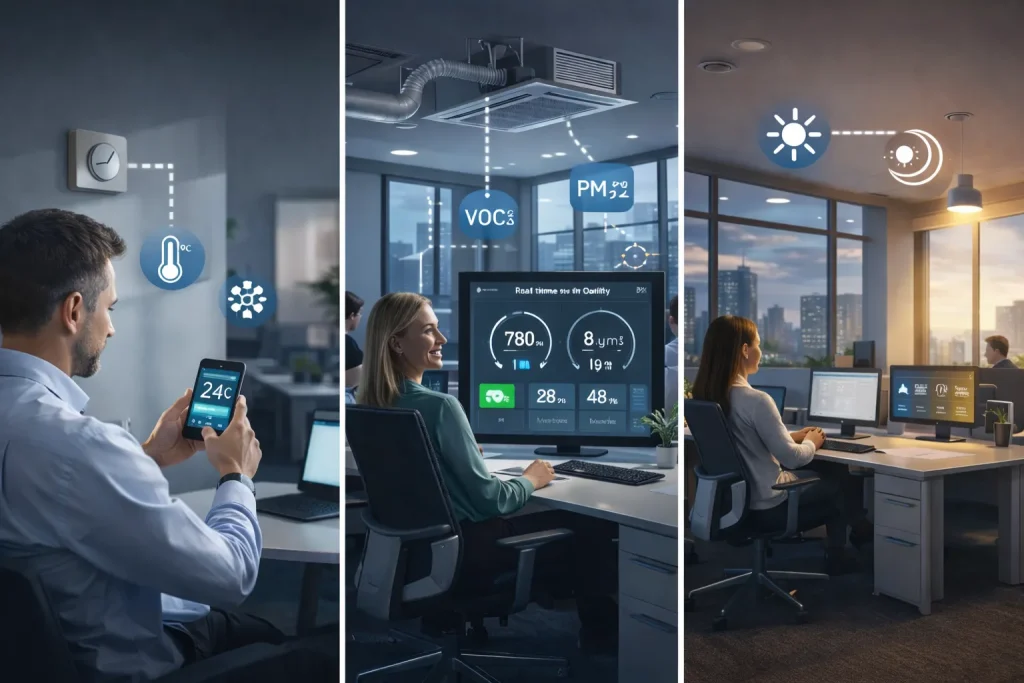
A smart building isn’t truly “smart” if it doesn’t keep its occupants comfortable and healthy. Fortunately, IoT technologies excel at maintaining indoor environmental quality – often better than traditional systems – by monitoring conditions in real time and responding dynamically. The result is more consistent temperatures, fresher air, and more personalization, leading to happier occupants. Impressively, studies have found that in commercial buildings, IoT integration yielded around a 30% improvement in perceived comfort (occupant satisfaction) while simultaneously reducing energy use by over 20%. In other words, with IoT you don’t have to choose between saving energy and keeping people comfortable – you can do both.
Thermal comfort: IoT-enabled HVAC systems keep temperature and humidity in the ideal range with far less fluctuation than conventional control. Instead of the typical cycle of over-cooling then over-heating (common in older thermostats), IoT sensors and AI controllers make continuous micro-adjustments. Studies have documented that IoT climate control can reduce temperature swings by several degrees compared to legacy systems. Occupants experience a more stable environment – no more hot and cold spots or midday stuffiness. Moreover, IoT allows smart zoning and personalization. Wireless temperature sensors and smart thermostats can be placed throughout a space (instead of one thermostat for an entire floor), so the system knows exactly which areas are too warm or cool. Managers can easily reconfigure zones if floorplans change or if some rooms need different settings. Even more, IoT opens the door to occupant-centric control: for instance, smartphone apps or desk sensors that let individuals tweak the temperature or airflow at their location. This personalization has a big impact on comfort – one experiment reported a 25% increase in employee satisfaction when people could fine-tune their own workspace climate. Smart buildings increasingly offer such features (sometimes called “hyper-personalization”), allowing someone to, say, use an app to request slightly cooler air at their desk, which the system accommodates within set safe limits. By combining overall automation with individual preferences, the building ensures most people are comfortable, most of the time. And because the system continuously optimizes itself, it manages to do this efficiently, without the typical over-conditioning.
Air quality and ventilation: Indoor air quality (IAQ) is a huge factor in occupant comfort, health, and productivity. Stale air with high CO₂ levels can cause drowsiness and impair cognitive function – think of the afternoon meetign in a stuffy meeting room. IoT sensors for CO₂, volatile organic compounds (VOCs), particulate matter, and other pollutants keep a digital nose on the environment at all times. When CO₂ starts rising above, say, 1000 ppm in a conference room, the system automatically switches on ventilation fans or opens dampers to bring in fresh air. This demand-controlled ventilation ensures air stays fresh without needlessly blowing in outside air (which can waste energy if done excessively). Essentially, you get better air quality and less energy waste by ventilating exactly when and where it’s needed. The COVID-19 era has also put a spotlight on ventilation, and smart buildings are responding by monitoring airflow and filtration. IoT sensors can verify that filters are effective (e.g. monitoring pressure drop or particle counts) and even adjust air circulation patterns to minimize disease transmission. Many European workplaces now require continuous IAQ monitoring by law, and IoT makes compliance easy by logging data and sending alerts if air quality falls out of spec. From a comfort standpoint, occupants certainly notice the difference – no more stuffy rooms or mysterious odors. In fact, maintaining good IAQ can directly boost productivity and well-being. By keeping CO₂ in check and humidity in a comfortable 40–60% range, smart buildings help people stay alert and healthy. Some smart offices even display air quality dashboards (e.g. showing CO₂, temperature, humidity) to reassure occupants and encourage feedback.
Lighting and acoustics: Comfort isn’t just about HVAC and air – lighting quality and noise matter too. IoT-based human-centric lighting systems can adjust color temperature and intensity throughout the day to support occupants’ circadian rhythms (cool bright light in the morning, warmer softer light in the evening), which improves mood and alertness. They also respond to occupancy and even personal preferences (via apps or smart switches) to give employees control over lighting levels at their work area. Studies in schools and offices have found that smart lighting that adapts to tasks and daylight not only saves energy but also increases visual comfort (one study noted a 15% rise in reported visual comfort in sensor-equipped classrooms) and reduces complaints of eye strain. On the noise front, IoT sensors can monitor sound levels in open offices or public spaces and interface with sound masking systems or send alerts when noise exceeds certain thresholds, helping maintain a pleasant acoustic environment. While acoustic comfort is a newer frontier for IoT, some buildings use occupancy and noise data to dynamically control background noise or guide people to quieter spaces when needed.
Overall, a smart building creates a better indoor environment by continuously aligning it with occupant needs. It’s worth noting that comfort isn’t just a “nice to have” – it has real business impacts. Happier, more comfortable occupants are more productive and less likely to complain or request space adjustments. By some measures, productivity can increase and complaints drop dramatically after implementing IoT environmental controls. In commercial real estate, buildings that offer superior comfort (think well-ventilated, well-lit, personalized spaces) gain a competitive edge in attracting tenants and can command higher rents. Thus, investing in IoT for comfort pays off not only in energy terms but also in occupant performance and satisfaction. With energy efficiency and comfort going hand-in-hand, smart buildings truly deliver a win-win scenario.
Predictive Maintenance and Enhanced Safety Systems
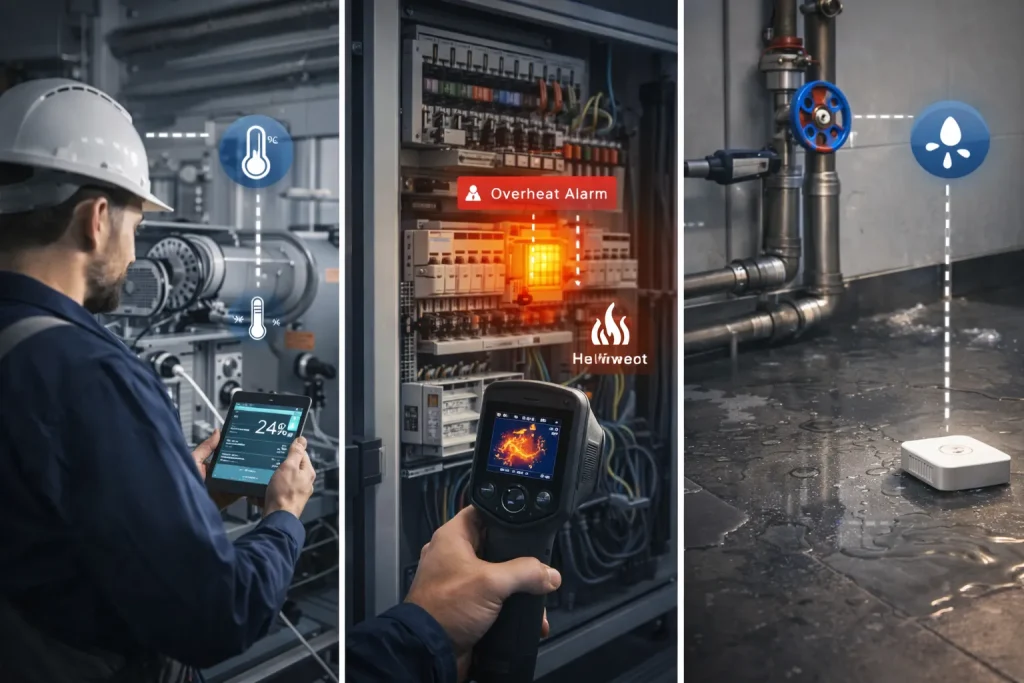
In addition to optimizing the environment, IoT plays a critical role in keeping building equipment reliable and occupants safe. Traditional facility maintenance is either reactive (wait until something breaks) or scheduled (inspect/replace on a fixed timetable). IoT enables a better way: predictive maintenance, where sensors continuously monitor the condition of equipment and AI analytics predict issues before they cause failures. The result is fewer breakdowns, less downtime, and safer operation of critical building systems like elevators, escalators, heating/cooling plants, and electrical infrastructure.
How does it work? Tiny wireless sensors or built-in IoT devices can measure parameters like vibration, temperature, motor current, voltage, or pressure on all kinds of building equipment. For example, a sensor on an elevator motor might track vibration patterns and notice a subtle change indicating a worn bearing; or a smart power meter on an HVAC compressor might detect it drawing more power than usual (a sign of decreasing efficiency or impending failure). These constant data streams are analyzed by cloud algorithms or on-site analytics, which can recognize the signatures of developing problems. AI-powered diagnostics have been shown to catch HVAC and machinery issues early – in one study IoT monitoring identified faults 27% sooner, and reduced equipment downtime by about 35% by enabling timely fixes. Similarly, building operators using predictive maintenance have extended the lifespan of systems like chillers, boilers, and elevators by 20%+, since repairs can be made at optimal times (preventing catastrophic damage). For building owners, this means major cost savings: fewer emergency repair calls, longer replacement intervals, and less disruption to operations.
Importantly, predictive maintenance is also a safety booster. Consider elevators: a smart elevator IoT system monitors factors such as motor torque, door operation cycles, and even car alignment. If an anomaly arises – say a door is slow to open or a cable tension is off – the system flags it for maintenance before it can strand passengers. This proactive approach reduces the risk of accidents or entrapments. Likewise, IoT monitoring on electrical panels can detect overheating wires or abnormal currents that could indicate an impending electrical fault or fire hazard; the system can then alert staff to intervene or even automatically shut off certain circuits. Water leak sensors placed in vulnerable areas (restrooms, server rooms, pump rooms) can catch leaks or flooding early and trigger valves to shut off water, preventing costly damage and safety issues from water on floors. In short, IoT sensors act as 24/7 electronic eyes and ears, guarding the building and its critical systems. They never get tired or skip a round – so nothing goes unnoticed.
Beyond equipment health, IoT contributes to occupant safety and security in other ways too. Many smart buildings integrate security cameras, badge readers, and alarms into the IoT ecosystem. For example, occupancy sensors can double as intrusion detectors after hours, linking to an alert system if movement is detected in a supposedly empty area. Smart access control systems (with IoT-enabled badges or smartphone credentials) not only secure the building but also generate data on occupancy that can be useful during emergencies – e.g., knowing how many people are on each floor during a fire drill. In emergencies, IoT systems improve response: sensors can automatically unlock doors, turn on emergency lighting, or direct first responders to the exact location of an issue. One real-world example is advanced smoke detectors and air quality sensors: if a fire starts or hazardous fumes are detected, an IoT-enabled building could automatically engage exhaust fans, release fire doors, and send targeted alerts or evacuation instructions to occupants’ phones, all within seconds. This kind of coordinated response is far faster than waiting for humans to notice and react.
Environmental safety is another aspect – IoT air quality sensors help maintain healthy conditions by detecting issues like extreme humidity (which can cause mold) or high levels of CO or VOC gases. For instance, a smart building might have CO sensors in the parking garage that kick on ventilation fans when car exhaust accumulates, or sensors in a lab that detect chemical fumes and alert occupants immediately. Modern “healthy building” initiatives, especially in Europe post-COVID, emphasize constant monitoring of indoor environmental factors for occupant safety. IoT makes this feasible and affordable at scale, since wireless sensors can be placed widely without expensive wiring.
In summary, IoT makes buildings safer and more resilient. By knowing the status of every critical system in real time, building managers can fix small issues before they become big ones – preventing outages of HVAC on the hottest day or avoiding a scenario where an elevator gets stuck with people inside. Tenants and visitors also feel safer knowing the building is smart enough to detect and respond to problems (some smart buildings even have digital displays showing “days since last air filter change” or real-time elevator status updates to build trust). And in the rare case something does go wrong, IoT ensures a swift, targeted response that minimizes harm. All of this reduces liability and enhances the reliability of building operations – a smart building is one that you can count on to function smoothly day in and day out, with far fewer unpleasant surprises.
Convenience and a Personalized Experience for Occupants
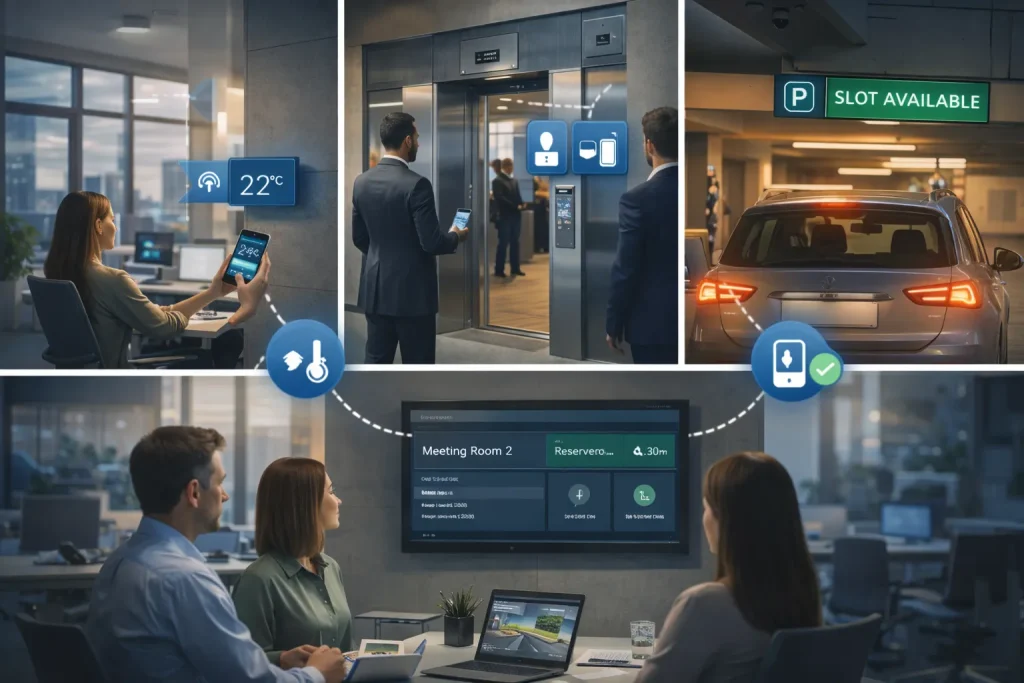
Beyond saving energy and preventing problems, IoT upgrades can make a building much more convenient and delightful to use. For building occupants – whether office employees, apartment residents, or visitors – smart building features can remove daily hassles and provide personalized control over their environment. This boosts satisfaction and productivity, effectively turning the building into a service that actively supports its users.
Consider some examples of IoT-enabled conveniences that are becoming increasingly common in modern smart buildings:
- Personalized climate and lighting: Tired of being too cold or hot at your desk? Smart buildings allow individuals to adjust their immediate environment via smartphone or desktop apps. You can set your preferred temperature or lighting level for your workspace, and IoT sensors will adjust local HVAC diffusers or smart bulbs to match your preference. No more one-size-fits-all settings – the building remembers your profile and can even pre-condition a room for you when a meeting is scheduled. This level of control was unheard of in traditional offices and makes occupants feel truly comfortable and in charge
- Smart elevators and reduced wait times: In IoT-equipped buildings, elevators don’t operate in isolation; they communicate and intelligently route themselves based on demand. For instance, if many people leave a meeting on the 10th floor, the system knows to send multiple elevators to that floor preemptively. Some buildings have smartphone integration where your badge app can call an elevator for you as you approach, or uses a destination dispatch system that groups people going to the same floor. The outcome is faster service and less crowded rides. A “smart elevator” can even optimize for energy, holding a car briefly if another person is detected walking toward the lobby, to combine trips. Occupants might not see the algorithms at work, but they feel the difference in shorter waits and smoother transit through the building.
- Seamless access and security: Forget fumbling for keys or access cards – IoT-enabled access control can use your smartphone or a wearable for secure entry. Doors and turnstiles recognize occupants (via encrypted credentials, Bluetooth signals, or biometrics) and open automatically. This not only adds convenience but also collects data that can be used for space planning (e.g. which entrances are most used) and safety (knowing who is in the building at any time). Visitors can get temporary digital passes sent to their phone for easy check-in. All of this streamlines the experience of moving through a secure building.
- Intelligent parking and navigation: For those who drive to the building, IoT can remove a major pain point: finding parking. Smart parking systems use sensors or cameras to monitor spot availability and direct drivers to open spots via signage or an app. No more circling the garage endlessly. Some systems even allow you to reserve a space or will guide you to an EV charging spot if you need it. Inside large complexes, indoor navigation kiosks or mobile apps help visitors find their destination (conference room, department, amenity) quickly with turn-by-turn directions, much like an indoor GPS. This saves time and frustration, particularly in hospitals, campuses, or shopping centers where finding your way can be daunting.
- Smart meeting rooms and services: IoT makes shared amenities easier to use. Conference rooms, for example, can be equipped with occupancy sensors that integrate with booking systems – if a room is booked but nobody shows up after 10 minutes, the system frees it up and notifies others of availability. Voice-activated interfaces allow occupants to do things like book a room or adjust AV equipment by simple commands, instead of fiddling with remotes and cables. Even ordering coffee or reporting a spill can be streamlined through building apps that route requests to the right staff. Essentially, the building becomes a responsive environment that listens and reacts to occupant needs.
- Wellness and amenity enhancements: Many IoT features also focus on occupant well-being. For instance, circadian lighting systems adjust throughout the day to support human health (cool bright light in mornings, warm dim light in late afternoons), helping reduce eye strain and improve sleep cycles. Sensors monitor noise and occupancy in fitness centers or lounges to prevent overcrowding and ensure a pleasant atmosphere. Air quality displays in lobbies might show real-time IAQ data, giving peace of mind (and even comparing indoor air to outside pollution levels – a perk on a smoggy day). In senior living or healthcare facilities, IoT wearables and presence sensors can detect falls or unusual inactivity, ensuring help is dispatched quickly to those in need. All these touches add up to an environment that actively cares for its occupants.
From an occupant’s perspective, a smart building simply feels better. You spend less time adjusting controls or contacting facility management, because so many things are automated and optimized in the background. The space adapts to you, not the other way around. This is a big plus for employers and building owners too – higher occupant satisfaction means better tenant retention, more productive employees, and a strong reputation for the property. In a competitive real estate market, offering a high-tech, convenience-filled environment can differentiate a building. We’re already seeing “smart building” certifications and ratings emerge, which quantify things like connectivity, health features, and user experience. It’s clear that occupant expectations are rising: people want their workplace or home to be as smart and connected as their phones and smartwatches. IoT is the key to meeting those expectations, transforming buildings from passive shelters into interactive partners in daily life.
Implementation Challenges and Future Outlook
With all these advantages, one might wonder why every building isn’t smart already. The reality is that implementing IoT in buildings can be complex, and there are challenges to overcome. Key hurdles include technology integration, data security, and upfront cost. A smart building may involve thousands of devices from different manufacturers – HVAC controllers, sensors, lights, security cams, etc. Ensuring they all speak the same language and work together (i.e. interoperability) is a persistent challenge. Industry standards like BACnet, KNX, Zigbee, and others try to address this, but many legacy systems use proprietary protocols. Often a building needs an IoT platform or middleware to integrate disparate systems. Choosing the right platform (with support for all needed devices) and planning for scalability is crucial.
Cybersecurity is another paramount concern. By connecting building systems to networks (and possibly the cloud), you introduce potential cyber risks. A breach in an IoT device could, in worst cases, lead to unauthorized control of building functions or theft (imagine hacked thermostats or door locks). Smart building deployments must therefore have strong security practices: encryption of sensor data, network segmentation, regular firmware updates, and monitoring for anomalies. The good news is that modern IoT products and standards recognize this and include robust security features (and regulations like GDPR in Europe enforce protections). Still, building operators need to be vigilant and often work with IT/cybersecurity experts when rolling out IoT at scale.
Then there’s the matter of cost and retrofitting. While IoT sensors are relatively cheap individually, installing a complete smart system in a large building is an investment. Some older buildings lack the wiring or infrastructure to easily connect new devices. However, this is where wireless IoT technologies shine. Low-power wireless sensors (using standards like LoRaWAN or NB-IoT) can be deployed without running new cables or doing major construction. Battery-powered sensors can operate for 5–10 years, sending data through the air from deep in basements or across entire campuses. This drastically lowers the barrier to entry for retrofits – even a 100-year-old building can be upgraded with smart capabilities by sticking wireless sensors in key places and using a cellular or LoRaWAN gateway to get the data online. As for cost, the energy savings (15–30% cuts in utility bills) and maintenance savings tend to provide a healthy return on investment, often in just a few years. Additionally, more and more building codes and regulations are starting to require certain smart features (as mentioned, the EU will soon require automation in large HVAC systems, and various cities mandate smart metering and lighting controls for new buildings). These factors are making IoT less of an optional luxury and more of an essential upgrade.
Looking ahead, the trend is clearly towards even smarter, more autonomous buildings. Advances in AI, edge computing, and digital twin technology are poised to make buildings self-optimizing in real time. For example, building digital twins (virtual models of the building and its systems) can simulate changes and find optimal settings continuously. AI algorithms will increasingly predict not just maintenance issues but also optimize space usage, cleaning schedules, and energy buying (e.g. coordinating with smart grids to use power when it’s cheapest or greenest). The integration with smart city infrastructure is another horizon – imagine buildings adjusting their consumption based on signals from the city grid or sharing data with city emergency services for faster response. The future building might also offer hyper-personalization, where every individual’s preferences (lighting, temperature, even background music) are learned and automatically provided wherever they go in the building. At the same time, sustainability will remain a driving force: net-zero energy buildings will likely use IoT plus onsite renewables and storage to dynamically balance and even trade energy with the grid.
It’s an exciting future, but one that requires careful planning and the right expertise to achieve. This is where working with an experienced partner can make all the difference.
Conclusion: Bringing It All Together with the Right IoT Partner
Smart building technology delivers proven benefits – lower energy costs, a smaller carbon footprint, superior comfort and air quality for occupants, proactive maintenance that prevents downtime, and modern conveniences that make spaces more enjoyable. As we’ve seen, even modest IoT deployments (like smart thermostats and occupancy sensors) can save 20% or more on energy and drastically improve how a building operates day-to-day. It’s no wonder the adoption of smart building solutions is accelerating across Europe and globally, driven by both economic ROI and regulatory pressure to improve efficiency.
Crucially, implementing these solutions doesn’t have to be overwhelming. While there are many moving parts – devices, networks, software, analytics – a knowledgeable integration partner can handle the complexity. IoT Squad specializes in delivering end-to-end smart building deployments as a cohesive solution. We take care of everything from selecting the optimal sensors and IoT devices, to installing secure networks (LoRaWAN, NB-IoT, Wi-Fi, or whatever fits best), to configuring the cloud dashboards and automation rules that run your building. Our team has deep expertise in bridging legacy building systems with the latest IoT platforms, all in a vendor-neutral way that prioritizes your needs (and avoids proprietary lock-in). The result is a seamless, unified smart building system where you can monitor and control all aspects of your facility from a single interface – energy usage, HVAC status, room occupancy, air quality readings, security alerts, you name it – with data logging and alerts set up according to your goals.
By partnering with IoT Squad, building owners and facility managers can focus on outcomes rather than wrangling devices or IT issues. We ensure the connectivity is reliable (leveraging our MVNO connectivity and private networking options for 24/7 data flow) and that all the sensors and controls are tuned to work in harmony. Moreover, we emphasize cybersecurity and privacy best practices from the start, so you can be confident your smart building is not just smart but also safe from hacking or data mishaps. Our solutions are tailored – whether you run a small office block or a huge multi-site campus, we right-size the technology to fit your scale and budget. Even if you want to start with a pilot on one floor, we can design it in a way that scales up to the whole portfolio over time.
In the end, our mission is to make your smart building journey smooth and successful. We love to see clients reach that “aha” moment when their energy bills drop or when they get a preventive alert that averts a major incident – and when occupants start commenting how comfortable and convenient the building has become. Those are the signs of a smart building delivering real value. Your building can be next. If you’re considering IoT upgrades or unsure how to begin, feel free to reach out to IoT Squad for a consultation. We’ll help you navigate the options (be it for energy management, comfort monitoring, smart security, or all of the above) and create a roadmap that meets your objectives. With the right strategy and support, you can transform your facility into a cutting-edge smart building that saves money, delights occupants, and stands as a forward-looking example of efficiency and innovation. Let us help you make your building truly smart – the payoff will be felt for years to come in comfort, safety, and cost savings. Welcome to the future of buildings, today.
References
- European Commission – BUILD UP
What makes a building ‘smart’: technologies driving energy efficiency - Transforma Insights
Smart buildings can reduce global energy consumption by 3–5% - Ghiai, M., Pahlevani, M. (2025) – ITcon
Energy efficiency and comfort impacts of IoT-enabled HVAC control - IoT For All
How integrated IoT solutions are creating smart, green, and healthy buildings
Related Resources
- SmartWhere™ Industry: Smart Building IoT Platform